
What is a tornado?
According to the Glossary of Meteorology, a tornado is “a violently rotating column of air, pendant from a cumuliform cloud or underneath a cumuliform cloud, and often (but not always) visible as a funnel cloud.” Literally, in order for a vortex to be classified as a tornado, it must be in contact with the ground and the cloud base. It is well-known that a tornado may not have a visible funnel. Mobile radars also have showed that tornadoes often extend outside an existing, visible funnel. At what wind speed of the cloud-to-ground vortex does a tornado begin? How close must two or more different tornadic circulations become to qualify as a one multiple-vortex tornado, instead of separate tornadoes? There are no firm answers.
How do tornadoes form?
The classic answer–“warm moist Gulf air meets cold Canadian air and dry air from the Rockies”. Most thunderstorms that form under those conditions (near warm fronts, cold fronts and drylines respectively) never make tornadoes. The truth is that we don’t fully understand. The most destructive and deadly tornadoes occur from supercells–which are rotating thunderstorms with a well-defined radar circulation called a mesocyclone.
What direction do tornadoes come from? Does the region of the US play a role in path direction?
Tornadoes can appear from any direction. Most move from southwest to northeast, or west to east. Some tornadoes have changed direction amid path, or even backtracked. A tornado can double back suddenly, for example, when its bottom is hit by outflow winds from a thunderstorm’s core. Some areas of the US tend to have more paths from a specific direction, such as northwest in Minnesota or southeast in coastal south Texas. This is because of an increased frequency of certain tornado-producing weather patterns (say, hurricanes in south Texas, or northwest-flow weather systems in the upper Midwest).
How do tornadoes dissipate?
The details are still debated by tornado scientists. We do know tornadoes need a source of instability (heat, moisture, etc.) and a larger-scale property of rotation (vorticity) to keep going. There are a lot of processes around a thunderstorm which can possibly rob the area around a tornado of either instability or vorticity. One is relatively cold outflow–the flow of wind out of the precipitation area of a shower or thunderstorm.
Many tornadoes have been observed to go away soon after being hit by outflow. For decades, storm observers have documented the death of numerous tornadoes when their parent circulations weaken after they become wrapped in outflow air–either from the same thunderstorm or a different one. The irony is that some kinds of thunderstorm outflow may help to cause tornadoes, while other forms of outflow may kill tornadoes.
How long does a tornado last?
Tornadoes can last from several seconds to more than an hour. The longest-lived tornado in history is really unknown, because so many of the long-lived tornadoes reported from the early-mid 1900s and before are believed to be tornado series instead. Most tornadoes last less than 10 minutes. The average distance tornadoes have traveled (based on path length data since 1950) is about 3-1/2 miles.
What is the Enhanced F scale?
The Enhanced F scale is a much more precise and robust way to assess tornado damage than the original F scale. It classifies F0-F5 damage as calibrated by engineers and meteorologists across 28 different types of damage indicators (mainly various kinds of buildings, but also a few other structures as well as trees).
The idea is that a “one size fits all” approach just doesn’t work in rating tornado damage. A tornado scale needs to take into account the typical strengths and weaknesses of different types of construction. This is because the same wind does different things to different kinds of structures. In the Enhanced F scale there will be different, customized standards for assigning any given F rating to a well built, well anchored wood-frame house compared to a garage, school, skyscraper, unanchored house, barn, factory, utility pole or other type of structure.
In a real-life tornado track, these ratings can be mapped together more smoothly to make a damage analysis. As with the original F scale, the enhanced version will rate the tornado as a whole based on most intense damage within the path.

What does a tornado sound like?
That depends on what it is hitting, its size, intensity, closeness and other factors. The most common tornado sound is a continuous rumble, like a nearby train. Sometimes a tornado produces a loud whooshing sound, similar to a waterfall, or the noise of open car windows while driving very fast. Tornadoes which are tearing through densely populated areas may be producing all kinds of loud noises at once, which collectively may make a tremendous roar. Just because you may have heard a loud roar during a damaging storm does not necessarily mean it was a tornado. Any intense thunderstorm wind can produce damage and cause a roar.
How does a tornado do damage?
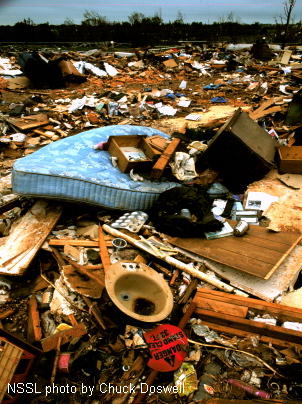
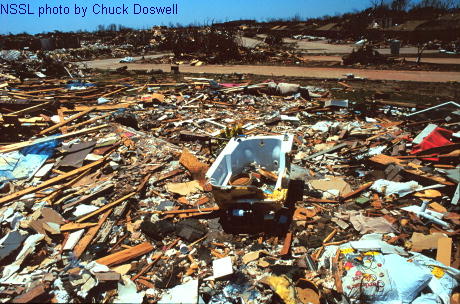
Most of the damage from a tornado happens one of two direct ways: exposure to extreme wind or impact by flying debris. In a developed area, a tornado essentially acts as a giant blender full of millions of small and large projectiles–boards, broken glass, nails, shingles, gravel, wire, cables, sheet metal, hardware, tree parts, whole trees, rocks, bricks, appliances, furniture, household items, even vehicles and large parts of houses. A dump truck thrown into a building by a nearby sub-vortex, for example, can do enormous damage even if the wind at the building site isn’t that strong on its own.
Sometimes a tornado will weaken a structure enough that parts or all of it collapses later due to structural weakness and imbalances. This is why people should not enter a heavily damaged home or other building until fire officials and an engineer can survey it.
Another reason is that hazardous materials may have been released by the tornado–such as natural gas, medical waste, gasoline, other dangerous chemicals, or sewage. Such “HAZMAT” releases, along with live electrical wires, also can be a cause of indirect tornado damage–either chemically or through fires. Broken water pipes can cause considerable water and flood damage also.

How can a tornado destroy one house and leave the next one almost unscratched?
Most of the time, this happens either with multiple-vortex tornadoes or very small, intense single-vortex tornadoes. The winds in most of a multi-vortex tornado may only be strong enough to do minor damage to a particular house. But one of the smaller embedded sub-vortices, perhaps only a few dozen feet across, may strike the house next door with winds over 200 mph, causing complete destruction. Also, there can be great differences in construction from one building to the next, so that even in the same wind speed, one may be flattened while the other is barely nicked. For example, a flimsy, unanchored mobile home may be obliterated while all surrounding objects suffer little or no damage.
TORNADO SAFETY
Prevention and practice before the storm: At home and at work, have a tornado plan in place, based on the kind of dwelling you live in and the safety tips below. Know where you can take shelter in a matter of seconds, and practice a tornado drill at least once a year. Have a pre-determined place to meet after a disaster. Flying debris is the greatest danger in tornadoes; so store protective coverings (e.g., mattress, sleeping bags, thick blankets, etc) in or next to your shelter space, ready to use on a few seconds’ notice. When a tornado watch is issued, think about the drill and check to make sure all your safety supplies are handy. Turn on local TV, radio or NOAA Weather Radio and stay alert for warnings. Forget about the old notion of opening windows to equalize pressure; the tornado will blast open the windows for you! If you shop frequently at certain stores, learn where there are bathrooms, storage rooms or other interior shelter areas away from windows, and the shortest ways to get there. All administrators of schools, shopping centers, nursing homes, hospitals, sports arenas, stadiums, mobile home communities and offices should have a tornado safety plan in place, with easy-to-read signs posted to direct everyone to a safe, nearby shelter area. Schools and office building managers should regularly run well-coordinated drills. If you are planning to build a house, especially east of the Rockies, consider an underground tornado shelter or an interior “safe room”.

Know the signs of a tornado: Weather forecasting science is not perfect and some tornadoes do occur without a tornado warning. There is no substitute for staying alert to the sky. Besides an obviously visible tornado, here are some things to look and listen for:
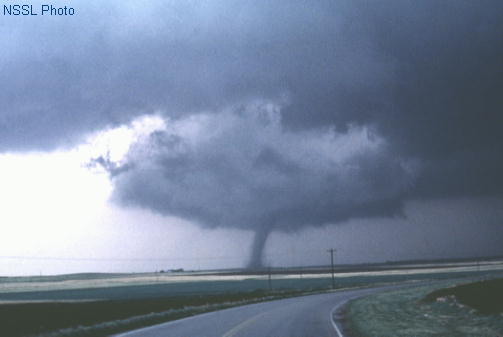
- Strong, persistent rotation in the cloud base.
- Whirling dust or debris on the ground under a cloud base — tornadoes sometimes have no funnel!
- Hail or heavy rain followed by either dead calm or a fast, intense wind shift. Many tornadoes are wrapped in heavy precipitation and can’t be seen.
- Day or night – Loud, continuous roar or rumble, which doesn’t fade in a few seconds like thunder.
- Night – Small, bright, blue-green to white flashes at ground level near a thunderstorm (as opposed to silvery lightning up in the clouds). These mean power lines are being snapped by very strong wind, maybe a tornado.
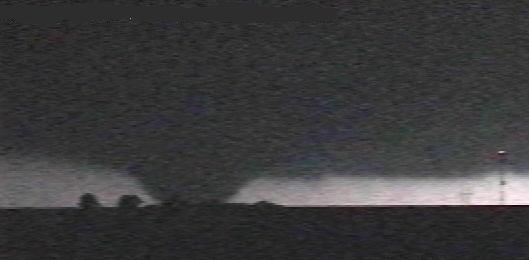
- Night – Persistent lowering from the cloud base, illuminated or silhouetted by lightning — especially if it is on the ground or there is a blue-green-white power flash underneath.
WHAT TO DO…
In a house with a basement: Avoid windows. Get in the basement and under some kind of sturdy protection (heavy table or work bench), or cover yourself with a mattress or sleeping bag. Know where very heavy objects rest on the floor above (pianos, refrigerators, waterbeds, etc.) and do not go under them. They may fall down through a weakened floor and crush you. Head protection, such as a helmet, can boost survivability also.
In a house with no basement, a dorm, or an apartment: Avoid windows. Go to the lowest floor, small center room (like a bathroom or closet), under a stairwell, or in an interior hallway with no windows. Crouch as low as possible to the floor, facing down; and cover your head with your hands. A bath tub may offer a shell of partial protection. Even in an interior room, you should cover yourself with some sort of thick padding (mattress, blankets, etc.), to protect against falling debris in case the roof and ceiling fail. A helmet can offer some protection against head injury.


In an office building, hospital, nursing home or skyscraper: Go directly to an enclosed, windowless area in the center of the building — away from glass and on the lowest floor possible. Then, crouch down and cover your head. Interior stairwells are usually good places to take shelter, and if not crowded, allow you to get to a lower level quickly. Stay off the elevators; you could be trapped in them if the power is lost.
In a mobile home: Get out! Even if your home is tied down, it is not as safe as an underground shelter or permanent, sturdy building. Go to one of those shelters, or to a nearby permanent structure, using your tornado evacuation plan. Most tornadoes can destroy even tied-down mobile homes; and it is best not to play the low odds that yours will make it. This mobile-home safety video from the State of Missouri may be useful in developing your plan.
At school: Follow the drill! Go to the interior hall or windowless room in an orderly way as you are told. Crouch low, head down, and protect the back of your head with your arms. Stay away from windows and large open rooms like gyms and auditoriums.
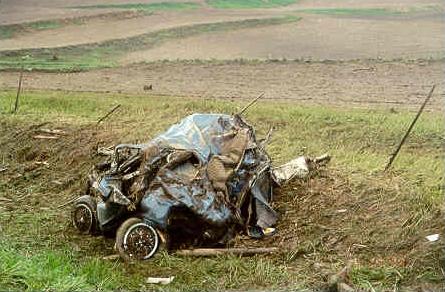
In a car or truck: Vehicles are extremely risky in a tornado. There is no safe option when caught in a tornado in a car, just slightly less-dangerous ones. If the tornado is visible, far away, and the traffic is light, you may be able to drive out of its path by moving at right angles to the tornado. Seek shelter in a sturdy building, or underground if possible. If you are caught by extreme winds or flying debris, park the car as quickly and safely as possible — out of the traffic lanes. Stay in the car with the seat belt on. Put your head down below the windows; cover your head with your hands and a blanket, coat, or other cushion if possible. If you can safely get noticeably lower than the level of the roadway,leave your car and lie in that area, covering your head with your hands. Avoid seeking shelter under bridges, which can create deadly traffic hazards while offering little protection against flying debris.
In the open outdoors: If possible, seek shelter in a sturdy building. If not, lie flat and face-down on low ground, protecting the back of your head with your arms. Get as far away from trees and cars as you can; they may be blown onto you in a tornado.
In a shopping mall or large store: Do not panic. Watch for others. Move as quickly as possible to an interior bathroom, storage room or other small enclosed area, away from windows.
In a church or theater: Do not panic. If possible, move quickly but orderly to an interior bathroom or hallway, away from windows. Crouch face-down and protect your head with your arms. If there is no time to do that, get under the seats or pews, protecting your head with your arms or hands.
How does the damage from tornadoes compare to that of hurricanes? The differences are in scale. Even though winds from the strongest tornadoes far exceed that from the strongest hurricanes, hurricanes typically cause much more damage individually and over a season, and over far bigger areas. Economically, tornadoes cause about a tenth as much damage per year, on average, as hurricanes. Hurricanes tend to cause much more overall destruction than tornadoes because of their much larger size, longer duration and their greater variety of ways to damage property. The destructive core in hurricanes can be tens of miles across, last many hours and damage structures through storm surge and rainfall-caused flooding, as well as from wind. Tornadoes, in contrast, tend to be a few hundred yards in diameter, last for minutes and primarily cause damage from their extreme winds.
Long ago, I was told to open windows to equalize pressure. Now I have heard that’s a bad thing to do. Which is right? Opening the windows is absolutely useless, a waste of precious time, and can be very dangerous. Don’t do it. You may be injured by flying glass trying to do it. If the tornado hits your home, it will blast the windows open anyway.
So if I’m in a car, which is supposed to be very unsafe, and shouldn’t get under a bridge, what can I do? Vehicles are notorious as death traps in tornadoes, because they are easily tossed and destroyed. Either leave the vehicle for sturdy shelter or drive out of the tornado’s path. When the traffic is jammed or the tornado is bearing down on you at close range, your only option may be to park safely off the traffic lanes, get out and find a sturdy building for shelter, if possible. If not, lie flat in a low spot, as far from the road as possible (to avoid flying vehicles).
In open country, the best option is to escape if the tornado is far away. If the traffic allows, and the tornado is distant, you probably have time to drive out of its path. Watch the tornado closely for a few seconds compared to a fixed object in the foreground (such as a tree, pole, or other landmark). If it appears to be moving to your right or left, it is not moving toward you. Still, you should escape at right angles to its track: to your right if it is moving to your left, and vice versa–just to put more distance between you and its path. If the tornado appears to stay in the same place, growing larger or getting closer–but not moving either right or left–it is headed right at you. You must take shelter away from the car or get out of its way fast! If the tornado starts to hit your car, get as low as you can while staying in your seatbelt, leaning down and away from the windows and windshield as far as possible.
What is a safe room? So-called “safe rooms” are reinforced small rooms built in the interior of a home, fortified by concrete and/or steel to offer extra protection against tornadoes, hurricanes and other severe windstorms. They can be built in a basement, or if no basement is available, on the ground floor. In existing homes, interior bathrooms or closets can be fortified into “safe rooms” also. FEMA has more details online. Those who have safe rooms, or any other kind of tornado shelter, should register them with the local fire department to help with rescue in case the entrance(s) are blocked by debris.
How to protect employees in a large, one-story commercial building that has pre-poured cement outer walls and a metal roof. We have no basement, the interior offices are drywall partitions with a dropped ceiling and there does not appear to be any area that is secure. This manner of construction is very common; however, it’s hard to know the integrity of any particular building without an engineering analysis, preferably by hiring a specialist with experience in wind engineering. Large-span, pre-fab, concrete and metal beam buildings are sturdy up to a “failure point”–which can vary a lot from site to site–but then crumple quickly and violently once that threshold is reached. A concrete-lined (and -topped) safe room with no windows is recommended. This is an emergency bunker that may double as a restroom, break room or employee lounge, but should be big enough to fit all occupants in the event of a warning. The insulated concrete form (ICF) is a very wind- and debris-resistant construction method for many small buildings or additions, whether doing new construction or retrofitting.
Are there smartphone apps that offer warnings for tornadoes and other kinds of dangerous weather? Yes, private companies have developed several apps that relay NWS tornado warnings to smartphones, based on their location and/or user-specified places. For example, you can set some apps to always provide warnings for certain ZIP codes or addresses of interest away from your current location, such as those of your home, business, or friends and loved ones. A search in your device provider’s app store should yield some that are highly rated, along with reviews by users.
What is tornado season? Tornado season usually means the peak period for historical tornado reports in an area, when averaged over the history of reports. There is a general northward shift in “tornado season” in the U. S. from late winter through mid summer. The peak period for tornadoes in the southern plains, for example, is during May into early June. On the Gulf coast, it is earlier during the spring; in the northern plains and upper Midwest, it is June or July. Remember: tornadoes can happen any time of year if the conditions are right!
How early in the year do tornadoes start happening? Tornadoes can happen any day or night of the year. Indeed, the earliest on modern record (since 1950) was two minutes into the new year–12:02 a.m. CST, 1 January 2011, in Attala County, MS. The average first-tornado date in the U.S. was January 11, for the entire 1950-2011 time frame. The latest first-tornado was on 15 February 2003, in Marengo County, AL, meaning that the nation had 45 days of tornado-free weather to start that year.
Does “global warming” cause tornadoes? No. Thunderstorms do.
Does El Nino cause tornadoes? No. Neither does La Nina. Both are major changes in sea surface temperature in the tropical Pacific which occur over the span of months. U. S. tornadoes happen thousands of miles away on the order of seconds and minutes. El Nino does adjust large-scale weather patterns. But between that large scale and tornadoes, there are way too many variables to say conclusively what role El Nino (or La Nina) has in changing tornado risk; and it certainly does not directly cause tornadoes. A few studies have shown some loose associations between La Nina years and regional trends in tornado numbers from year to year; but that still doesn’t prove cause and effect. Weak associations by year or season may be as close as the ENSO-to-tornado connection can get–because there are so many things on the scales of states, counties and individual thunderstorms which can affect tornado formation.
Why does it seem like tornadoes avoid downtowns of major cities? Simply, downtowns cover tiny land areas relative to the entire nation. The chance of any particular tornado hitting a major downtown is quite low–not for any meteorological reason, but simply because downtowns are small targets. Even when tornadoes hit metro areas; their odds of hitting downtown are small out of space considerations alone. For example, downtown Dallas (inside the freeway loop) covers roughly three square miles–Dallas County, about 900 square miles. For a brief tornado in Dallas County, its odds of hitting downtown are only about 1 in 300. Still, downtown tornadoes have happened, including at least four hits on St. Louis alone. The idea of large buildings destroying or preventing a tornado is pure myth. Even the largest skyscrapers pale in size and volume when compared to the total circulation of a big tornado from ground through thunderhead.
Source: NOAA / National Weather Service Website and Articles.